
Industrial Internet of Things Impact and Adoption
Brett May | Unlock the power of the Internet of Things
CONFIDENTIALITY1 Confidentiality2 Industrial Internet of Things 2019 impact and adoption

This is a modal window.
McKinsey & Company 2 Brett May Head of M&A and Venture Capital (GE Software, Cisco Services) Head of Business Development (Cisco Emerging Technology Group) Prior experience COO Big Data Startup (MoodLogic) @McKinsey COO IoT service line Co-lead in Digital M&A/VC consulting efforts Clients Served- Private Equity, Industrial, High Tech, Telecom Software & Database Developer/Architect (Sparta, Andersen)
McKinsey & Company 3 Years to double per capita GDP 2000 1900 1800 1700 United Kingdom 154 United States 53 Germany 65 South Korea 10 China 12 India 16 Japan 33 Country Population at start of growth period (million) 9 10 28 22 1,023 822 48 Industrialization happening 10x faster at 300x prior scale
McKinsey & Company 4 GDP of G19 1 Compound annual growth rate, % 1.7 0.3 1.8 1.8 Employment growth Productivity growth Next 50 years at historical productivity growth 2.1 -40% Past 50 years 3.6 1 and Nigeria NOTE: Numbers may not sum due to rounding SOURCE: The Conference Board Total Economy Database; UN Population Division; McKinsey Global Institute analysis GDP growth would slow by ~40% given shifting demographics, unless productivity were to increase
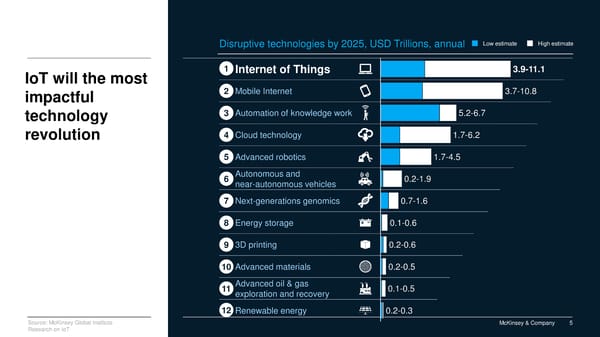
McKinsey & Company 5 Internet of Things Advanced robotics Mobile Internet 0.2-0.5 Automation of knowledge work Energy storage Cloud technology Autonomous and near-autonomous vehicles Next-generations genomics 3D printing Advanced materials Advanced oil & gas exploration and recovery Renewable energy 0.7-1.6 3.9-11.1 3.7-10.8 5.2-6.7 1.7-6.2 1.7-4.5 0.2-1.9 0.1-0.6 0.2-0.6 0.1-0.5 0.2-0.3 Low estimate High estimate Disruptive technologies by 2025, USD Trillions, annual IoT will the most impactful technology revolution 12 11 10 9 8 7 6 5 4 3 2 1 Source: McKinsey Global Institute Research on IoT
McKinsey & Company 6 9 settings have $4-11T of potential economic impact from IoT... ~ ¾ industrial or enterprise Source: McKinsey Global Institute Research on IoT Home Chore automation and security $200-350B Retail environments Automated checkout $410B-1.2T Outside Logistics and navigation $560-850B Worksites Operations optimization/ health and safety $160-930B Factories Operations and equipment optimization $1.2-3.7T Cities Public health and transportation $930B-1.7T Offices Security and energy $70-150B Human Health and fitness $170B-1.6T Vehicles Autonomous vehicles and condition-based maintenance $210-740B
McKinsey & Company Now more connected things than people 2013 2009 2007 2008 2010 2011 2012 2014 2015 2017 2016 12B+ Connected things* SOURCE: Strategy Analytics, McKinsey analysis 2018 *Excludes PCs, phones and tablets 7.6B 6.7B People
McKinsey & Company 8 McKinsey & Company Industrial IoT impact already felt widely
McKinsey & Company 9 "The Future is already here, it’s just not evenly distributed” — William Gibson Piloting vs Deploying IoT (%) Just starting Actively piloting Deploying at scale Time Spent Piloting (%) < 1 year 1-2 years > 2 years Only 1/3 are beyond pilot 85% of Pilots last over a year SOURCE: 2018 Survey of 301 IoT practitioners; McKinsey Analysis


This is a modal window.
McKinsey & Company 10 Revenue impact Cost impact Negligible or negative 1- 5% 10%+ 5 -10% Unknown ▪ 58% reported 5% or more revenue increase from IoT SOURCE: 2018 Survey of 301 IoT practitioners; McKinsey Analysis Note: >75% of respondents were “well beyond pilot phase” and/or offered “mature IoT solutions” Impact ▪ 46% reported 5% or better cost reduction Economic benefit enjoyed by the 1/3 beyond pilot is solid
McKinsey & Company 11 Financial impact per use case vs number of use cases Implementing more IoT use cases correlates with better financial impact Effect levels out around 30 use cases Increasing number of use cases Financial impact score R² = 0.58 0 10 20 30 40 0 10 20 30 40 50 60 Source: 2018 survey of 300+ IoT practitioners; McKinsey analysis
McKinsey & Company 12 Source: 2019 survey of 1400 IoT practitioners; McKinsey analysis Quality and customer experience are the most cited non-financial benefits 347 346 181 Improved quality 269 Better customer experience Other Improved worker productivity Worker health/safety 10 Most valuable intangible benefit Percent of responses
McKinsey & Company 13 Non-financial benefit: The Internet of Macaws
McKinsey & Company 14 The top 3 challenges in GTM and Org have been stable over time; Cybersecurity has emerged as a top tech challenge Number ranking item #1 or #2 (of 7 options per category) Cybersecurity concerns or weaknesses Data wrangling (cleaning, moving, formatting, joining etc.) Integration of legacy systems (ERP, MES, CRM etc) 412 513 432 Customers don’t perceive/believe the value of IoT 399 Customers perceive value but don’t want to change Challenges in establishing pricing 455 478 439 534 540 Getting the business leaders to buy in and own the solution Recruiting and retaining to the IoT -savvy talent needed to deliver Getting the functional teams to work together (IT, marketing, finance etc) Trend vs. Q2’18 New to top 3 New to top 3 New to top 3 New to top 3 Top 3 IoT Technical Challenges Top 3 IoT Go To Market Challenges Top 3 IoT Organizational Challenges
McKinsey & Company 15 “If you could change only one or two things in order accelerate your IoT program, what would they be?” 256 238 206 198 Add technical talent Keep solutions more simple/straightforward Be more rapid and agile in development Increased collaboration with prospective customers/users Design a more comprehensive/ transformational solution 213 Source: 2019 survey of 1400 IoT practitioners; McKinsey analysis; Number of responses
McKinsey & Company 16 Talent continues to be a barrier with data engineering surpassing data science as scarcest skillset Yes No 37 63 Hiring and retaining IoT talent a significant barrier to success 343 324 318 288 253 220 164 IoT -savvy product management Data engineers (data cleaning, data organization) Communications Specialist Data scientists Agile software development professionals Sensor and endpoint hardware specialist Connected hardware engineers who understand legacy equipment IoT -savvy executives 401 What kinds of skillsets are the hardest to attract and retain? Q3_11 BASE: (Total: N = 1265) Source: 2019 survey of 1400 IoT practitioners; McKinsey analysis Percent of responses Number of responses
McKinsey & Company 17 IIoT at scale requires data engineering even more than data science SOURCE: AutoNews, AWS,, Might Ai Collection Classification Interpretation
McKinsey & Company 18 Separating Leaders from Laggards McKinsey & Company 18
McKinsey & Company 19 We segmented IIoT “leaders” from the “laggards” by scope and scale of impact “Leaders” Got the most economic impact from IoT “Laggards” Got the least economic impact from IoT % Revenue impact or Cost Reduction 52 50 198 4 -8% impact 292 609 > 8% impact 302 < 4% impact
McKinsey & Company 20 Some elements separate leaders from laggards Of those getting highest economic impact... 34% 28% Leaders lead from the top More Likely to have CEO as champion More likely to have CEO as day to day lead Leaders value certain things more More likely to prioritize dedicated IoT tech talent #1 priority More likely to prioritize a strong business case #1 priority 52% 30% 86% Leaders make similar organization decisions 91% Have a Chief Digital Officer... but seldom ( 17 %) have IoT report there Have a separate IoT organization.. Are 70% more likely to have it reporting to the CEO, CTO or head of products
McKinsey & Company 21 175% Rely on partners for SW development more likely to 39% In-house system integration capability less likely to emphasize IoT platform to support an ecosystem for external developers more likely to require 167% Leaders look outside for capability acceleration *No laggard cited business process change as a key success factor Those getting highest economic impact...
McKinsey & Company 22 Top 5 Key Success Factors of Leaders– first 3 all involved design Note: Overall % revenues and cost reductions for respondents who ranked each value as 1 as drivers of success 101 93 90 87 86 Dedicated Technical talent made a difference Designed a very comprehensive/ transformational solution Kept solution very simple/ straightforward Successful collaboration with prospective customers/users Successful process engineering/ re-engineering Financial impact score of those listing this as #1 KSF
McKinsey & Company 23 McKinsey & Company Design thinking starts with the user journey
McKinsey & Company 24 Technology
McKinsey & Company 25 Advanced technologies being used to develop or IoT or supported for customers IIoT practitioners frequently Use and Sell advanced technologies Virtual Reality Wearables - activity or biosignal monitoring 27% Artificial Intelligence/Machine Learning Computer Vision Stationary Robots Wearables - location tracking Autonomous/Self -driving vehicle Augmented Reality 40% Drones 30% Smart Textiles 47% 35% 33% 31% 26% 23% 3% 22% 24% 21% 19% 23% 21% 23% 18% 16% 2% BASE: (We USE this technology for IoT purposes: N = 1400;We provide this technology to others: N = 1036) Source: 2019 survey of 1400 IoT practitioners; McKinsey analysis Number of responses Number of responses Those who use And also support or provide...
McKinsey & Company 26 Users and supporters of advanced technologies and endpoints get better returns Note: Advanced technologies were defined as: Augmented Reality, Virtual Reality, Artificial Intelligence/Machine Learning, Drones, Stationary Robots, Autonomous/Self-driving vehicle, Wearables - activity or biosignal monitoring, Wearables - location tracking, Smart Speaker (e.g., Alexa) 94 51 68 No advanced tech or endpoint Advanced tech user Advanced tech provider /supporter - 54% Financial impact score
McKinsey & Company 27 Top 5 priorities when buying industrial IoT products Priorities have changed over time; Cybersecurity has come to the top Most important IoT product purchase factors besides basic function Top 3 of 12 analysis Note: Total respondents = 1161 312 290 251 235 206 Strong cybersecurity Reliability Compatibility with existing enterprise software (e.g. ERP, CRM) Compatibility with installed production hardware Ease of use by end user Number of responses
McKinsey & Company 28 Fish tank or Phish tank? Stalked by Alexa?
McKinsey & Company 29 If yes, how severe was the damage? Source: 2019 survey of 1400 IoT practitioners; McKinsey analysis About half of IIoT users have suffered malicious cyber hacks and many suffer damage (little changed from 2018) 47% Not that I know of Yes 53% 22 6 No appreciable damage / loss Minor damage / loss 27 Moderate damage / loss High damage / loss Severe / suffered significant reputational damage as a result 8 37 [Q5_2] To the best of your knowledge, BASE: (Total: N = 1265) Has one of your IoT products or solutions ever been the target of a malicious attack? Percent of responses
McKinsey & Company 30 If yes, how severe was the reputational damage? Source: 2019 survey of 1400 IoT practitioners; McKinsey analysis White Hat hacking has become a threat to reputations in IIoT 39% Yes 61% Not that I know of Has one of your IoT products or solutions ever been the target of a white-hat attack for publicity? 28 8 No appreciable damage Minor Moderate Severe, public damage High 32 10 22 Percent of responses
McKinsey & Company 31 Cyber attackers have not derailed IIoT 54% of IoT Leaders report high confidence in their Cyber security posture vs. only 16% of laggards.... Even though Leaders report having been attacked 2X as often
Cyber attackers have not 54% of IoT Leaders report high derailed IIoT confidence in their Cyber security posture vs. only 16% of laggards…. Even though Leaders report having been attacked 2X as often McKinsey & Company 31
McKinsey & Company 33 Extra Slides
McKinsey & Company 34 Uncertainty deters cyber security spending Install base, standards and attack vectors What deters investing or focusing on security for IoT? (top 3 of 10 analysis) Challenges in maintaining an inventory/ knowledge of all connected devices Regulatory uncertainty I rely on my IoT vendor for security There are so many different attack vectors that we don’t know which ones to prioritize Hard to find talent 335 306 290 274 270 Note: Total respondents = 1400 Number of responses
McKinsey & Company 35 The AI good news: 2019 ≠ 1980 SOURCE: Dave Evans (April 2011) "The Internet of Things: How the Next Evolution of the Internet Is Changing Everything” 2015 1980 Costs of data storage and processing 1950’s 1980’s 2010’s Deep Learning A branch of ML Machine Learning A major approach to realise AI Artificial Intelligence The science of making intelligent machines Maths Data availability Basic demo- graphic data (e.g., city, income) Trans- actions data (e.g., ATMs, mobile- apps) Gov. agencies (e.g., tax payment report, updated demo- graphic data) Regular survey / satisfaction data Call center (e.g., customer interaction notes) Inputs from RMs (e.g., sales logs) Telcos (e.g., top-up patterns, monthly bill payments) Wholesalers (e.g., payment history for SMEs) Utilities (e.g., payment record) Website navigation data Video analysis of customer footage Social media sentiment IoT data
McKinsey & Company 36 Companies investing in AI by industry SOURCE: McKinsey, Spiderbook analysis 1.94% 2.04% 2.15% 2.35% 2.55% 2.66% 3.37% 4.19% 8.78% Marketing And Advertising Semiconductors Financial Service Government Administration Automotive Retail Telecommunications Research Internet Software Information Technology Services 32% 1.84% 1.74% 1.63% 1.63% 1.53% 1.33% 1.33% 1.33% 1.33% 0.92% Marketing And Advertising Telecommunications Management Consulting Banking Financial Service Other - consumer Retail Research Other - Industrial Other - public sector in digital and data based businesses 60% AI is not yet scaling in the physical world
McKinsey & Company 37 McKinsey & Company 5 Takeaways about AI/Machine Learning in IoT Financial impact comes with volume 03 China leads adoption: 80% at scale use it 02 AI/ML adoption accelerating in IoT: 60% 01 Satisfaction comes with solution maturity 04 Laggards in IoT were much less satisfied (60%) with AI/ML than leaders (97%) 05
McKinsey & Company 38 McKinsey & Company Edge Computing is becoming mainstream SOURCE: McKinsey, “New Demands, New Markets: What Edge Computing Means for Hardware Companies” – Oct 2018 Edge computing represents a potential value of $175-215B in hardware by 2025 Travel, transport, and logistics 1 Hardware value includes opportunity across the tech stack (i.e., the sensor, on-device firmware, storage, and processor) and for a use case across the value chain (i.e., including edge computers at different points of architecture) % of total edge use cases 2025 hardware value 1 $B Industry 2025 hardware value 1 $B % of total edge use cases Industry Cross-vertical Retail Media and entertainment Public sector and utilities Global energy and materials 9-17 16-24 32-40 35-43 20-28 17-25 1-5 2-7 4-11 5-13 5-13 4-11 Advanced industries Healthcare Infrastructure Chemicals and agriculture Banking and insurance Consumer 10% 10% 6% 5% 1% 4% 24% 9% 10% 1% 10% 13%
McKinsey & Company 39 McKinsey & Company With IoT transformation, changing the organization brings its own set of pain points Digital talent doesn’t stay here long because there is nowhere for them to grow – SVP of Digital BU, Media It’s not the technology that’s the hard part, it’s the culture change – CEO, Software The business heads don’t take me seriously – how can I get them to adopt new technology? – Chief Digital Officer, Global Bank The innovation committee sits in an ivory tower and isn’t close enough to the customer needs – GM of Digital BU, Media We’re going to see more change in financial services in the next five years than we saw in the past 30 – CEO, Payments The need to radically retrain and upgrade the skills of employees is the greatest challenge we’ll face in our careers – CEO, Telecommunications
With IoT transformation, changing the organization brings its own set of pain points The need to radically retrain and We’re going to see more upgrade the skills of employees change in financial services is the greatest challenge we’ll face in the next five years than we in our careers saw in the past 30 –CEO, Telecommunications –CEO, Payments Digital talent doesn’t stay It’s not the technology that’s here long because there is the hard part, it’s the culture nowhere for them to grow change –SVPof Digital BU, Media –CEO, Software The innovation committee sits in The business heads don’t take me an ivory tower and isn’t close seriously – how can I get them to enough to the customer needs adopt new technology? –GM of Digital BU, Media –Chief Digital Officer, Global Bank McKinsey & Company McKinsey & Company 39