
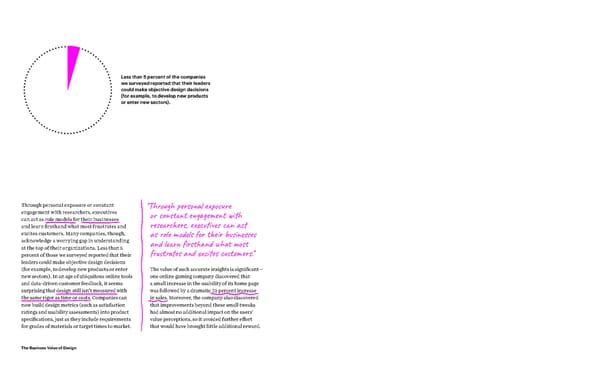
Through personal exposure or constant engagement with researchers, executives can act as role models for their businesses and learn firsthand what most frustrates and excites customers. Many companies, though, acknowledge a worrying gap in understanding at the top of their organizations. Less than 5 percent of those we surveyed reported that their leaders could make objective design decisions (for example, to develop new products or enter new sectors). In an age of ubiquitous online tools and data-driven customer feedback, it seems surprising that design still isn’t measured with the same rigor as time or costs. Companies can now build design metrics (such as satisfaction ratings and usability assessments) into product specifications, just as they include requirements for grades of materials or target times to market. "Through personal exposure or constant engagement with researchers, executives can act as role models for their businesses and learn firsthand what most frustrates and excites customers." The value of such accurate insights is significant— one online gaming company discovered that a small increase in the usability of its home page was followed by a dramatic 25 percent increase in sales. Moreover, the company also discovered that improvements beyond these small tweaks had almost no additional impact on the users’ value perceptions, so it avoided further effort that would have brought little additional reward. Less than 5 percent of the companies we surveyed reported that their leaders could make objective design decisions (for example, to develop new products or enter new sectors). The Business Value of Design
 The Business Value of Design Page 17 Page 19